Pages

    16 September 2010

    PGA Tour: Taking A Week Off

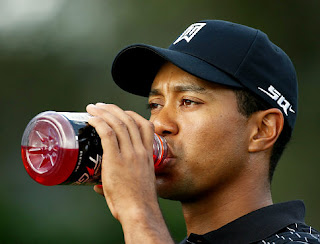
    Tiger Woods: driven to drink


    The Tour, not me.

    The PGA Tour concedes this weekend's television viewing to Football, NFL and College varieties, and we have to wait until next weekend for the Tour Championship at Atlanta's East Lake GC.
    And then, when the Atlanta dust has settled and $10M has been won, not to mention the $295K minimum bounty that goes to each of the 30 combatants, we'll be back for the final five events of the season, the Fall Series and lots to play for.

    Although next week's field are secure with their "playing privileges" for 2011, there are a number of well known golfers striving to reach the magic top 125 on the money list. Assuming this year's threshold to be about $800K, the following are among those who still have money to make:
    Duval, Imada, Curtis, Baddeley, Sutherland, Baird, Austin, Stenson and Stroud are currently inside the top 125.
    And these are on the outside looking in:
    McCarron, Byrd, Weir, RS Johnson, Quinney, Quigley, Goggin, MacKenzie, DiMarco, Pampling, Jeev Milkha Singh, Owen and Chopra. Oh, and Daly of course.

    The first Fall Series event, the same weekend as the Ryder Cup, is the Viking Classic in Mississippi, to be followed intermittently by stops in Georgia, Las Vegas (Martin Laird's title defence), California and Orlando.
    But some of these players have been sharpening their games on the Nationwide Tour, Daly and Chopra, MacKenzie and Mallinger, Stroud, Goggin and Quinney, while others are using the Nationwide as a rehab stop prior to returning to Tour business. Rich Beem for one. And Carl Paulson for another.

    You don't remember Paulson? Only six years ago he was a Tour regular, the 54-hole leader of The Players. But back injuries have kept him off Tour for more than five years now. He has a Major Medical Exemption for 2010 which will doubtless be carried over to 2011, but it's become a different game in his absence and we'll watch his progress with interest and best wishes.

    Some other thoughts on recent events:

    *Those disparaging the validity of a World Ranking system based on 2 years' results that still has Tiger Woods at #1 will have been interested to see Vera Zvonareva climb from 8 to 4 on the one-year WTA Rankings following her defeat in the US Open Tennis final. Meanwhile, winner Kim Clijsters slipped from 3 to 5.

    *Paul Casey's case for inclusion in Montgomerie's Ryder Cup Team has earned a lot of ink. Given that support of the European Tour was clearly a factor in the Team "picks", it is worth noting the number of 2010 "European Tour" qualifying events played by some golfers:
    Casey and McIlroy: 12
    Donald and Poulter: 11
    Harrington: 9
    Rose: 6

    *There will be continuing arguments about qualifying for the European Team, but there is surely a case for remembering that some European Tour golfers who have seldom played in the States have played pivotal roles in earlier European wins.
    Mike Cowan was caddying for Fred Couples when Christy O'Connor Jnr laced his 2-iron 200 yards to the Belfry's 18th in 1989: "One of the most phenomenal shots in the history of the game," said Fluff, whose man Fred flared a 9-iron wide of the green.
    Rafferty, James and Canizares were among others to win that day, and the recent list of successful Euro-only players is well known.

    Is it possible that the esprit de corps, so famously a part of European victories of the past, is less a force when the contestants are playing against those they play with week in, week out on Tour? The Presidents Cup effect??
    Regardless, it will be interesting to measure the relative successes of the Molinaris, Fisher and Hanson in Wales.

    Past year's Nationwide Tour events have featured European golfers enjoying success, Richard Johnson leading money-winner just three years ago, the same year Martin Laird "graduated". Gronberg and Bjornstadt earned Tour cards on the back of Nationwide success last year, but few Europeans have competed this year, Jonas Blixt and Gary Christian the only full-timers and neither close to their card at present.

    But you know that the stars of tomorrow's PGA Tour will mostly come from the Nationwide, and Chris Kirk, Kevin Chappell and Jamie Lovemark are certain to be Tour regulars next year, likely all making quite a splash.
    As is Tommy Two Gloves Gainey, third in money won and who would bet against him following in the footsteps of Boo Weekley a few years ago? Both earned their cards perhaps before they were ready, went back to the Nationwide to consolidate their earlier success and, in Boo's case the rest is history. Gainey's coming to a tournament near you. Or at least me.

    Dream partners? Nightmare opponent?

    Of this year's Ryder Cup teams (including all the potential candidates for US wildcards);

    a) Who would you most like to partner in foursomes and fourballs?

    b) Who would you least like to be playing against?

    I think Luke Donald is an ideal foursomes partner and Rory McIlroy for fourballs.

    I'd hate to be up against Steve Stricker - he's super consistent, but yet even if you beat him it somehow doesn't quite have the kudos of beating Woods, Mickelson or Furyk.

    14 September 2010

    Camilo Villegas - A future major champion?

    Watched the USPGA with interest last week and the man I followed most closely was Camilo Villegas as he is my favourite golfer and I had a few euros on him... This guy played really good golf all week and only for a few silly mistakes would have won this tournament! He really rallied on day 4 and had he to par 9 and 10 of his final round he would have found himself in a playoff... Ifs and buts I know but still it was a really good performance from him!

    Anyway what I am wanting to know is do you think Camilo will win a major? I think next year he will definately challenge in at least one of the majors and I will be very surprised if he does not win a major in the next couple of years...
    Thoughts?

    Chipping With Your 3-Wood

    A 3-wood is an option for chipping.

    It's played the same as the bladed wedge but has the advantage of being a club with a wide sole so it skids better through the rough.

    Lastly, a shot that Michael Campbell showed me is to get the ball way outside your right foot.

    Keeping the left shoulder low, make a short chop-swing at the ball with your most lofted club.

    The ball will skid out and then actually check on its way to the hole.

    A great shot from a tall collar, but it needs practice.

    6 June 2010

    Putting without looking...

     Has anyone else tried this, or heard of it? I played with a friend-of-a-friend last weekend. He's an 8 handicap, hits the ball very nicely and on the day he hit a 78. But one thing he did amazed me.

    When he putted (at the moment of impact), he didn't look at the ball, he looked at the hole. His set-up was much like anyone else's - club down, get feet in position, get body set, look at hole, look at ball etc. However, his last movement before striking the ball, once he was completely set and still, was to move his eyes to the hole (by tilting his head), hold for about 2 seconds, then make the putt.

    His reasoning, which I understand, is that once he is set and in position, he doesn't need to look at the ball to make a good contact, and that by focusing on the hole he had a much better feel and gauge of the distance, which he had previously been struggling with. I have seen this done on the practice green before but he is the first player i have seen take this onto the course. Fair play to the bloke though, as I say he hit 78 and putted like a pro, absolutely brilliant.

    Anyone tried anything similar?

    3 June 2010

    Match Fit for Golf?

    After most bookmakers making Tiger favourite for the US Masters after his hiatus from golf, I was having a ponder about whether it really matters if you haven't played competitively for a while and then come back. Clearly this is assuming there is no physical injury involved.

    Surely golf is one of the few sports where you can recreate the same conditions in practise as you would in competition, you are always playing the course rather than somebody else. In Woods' case, surely a month or so is easily enough time to hone a swing when you have swung a club for most of your life anyway.

    In football or tennis it would be hard to recreate the intensity that a live opponent would bring, this really is not the case in golf. In fact, you could say he could be gaining an advantage by spending all his time practising shots that will be called upon to use at Augusta rather than spending time playing other courses. But equally he can play as many rounds as he likes between now and the start of the Masters. And he can play them with other top pros to add an element of competition.

    Sure we have no idea how he will be mentally, he has admitted as much himself. But purely from a physical and technical point of view I cant see any reason why missing tournaments others have played should make much of a difference.

    30 May 2010

    Advice from Nicklaus - approaching greens

    Taken from "The best of Nicklaus' golf (1992)" here are some points worth discussing.

    Lesson 50 Principles of position Play
    -"when you pass a hole you'll be playing later do you note the pin position? I'd bet that not 5 in a hundred weekend golfers do it habitually"
    -"there is an ideal route for playing every hole of golf"
    -"go to the movies"

    Lesson 51 Iron shot strategy
    -"always and I mean always tee the ball up on par-3 holes"

    Lesson 52 Distance factors in approaching
    -"On all approach shots I take a club that I believe will get me up, even if I miss it slightly"
    -"trouble behind greens is frequently less severe than hazards in front"

    Lesson 53 When to gamble on approach shots
    -""working in from the middle.""
    -"by aiming say 20 feet to the left or right of the pin and trying to fade or draw the ball in toward it, I give myself a much greater margin for error. Now I can miss the shot by 40 feet and still keep the ball within 20 feet of the hole."

    I doubt these points will have been raised with McIlroy but definitely most of them I rarely see my playing partners doing in Club golf.

    My routine is:
    1. Think about the approach before the previous shot.
    2. Work out the distance to the front, middle, and back of the green.
    3. Consider the best side to miss the green. (not that I usually do)
    4. Consider the behaviour of the ball on the green.
    5. Check the lie of the ball (tight,rough, divot, downslope etc.)
    6. Check the wind (grass, tree tops, flag)
    7. Pick a spot that will leave an uphill putt if possible.
    8. Once decided on the yardage and effect of the wind I pick the appropriate club and programme the swing length with a few practice swings.
    9. Choose a shot shape into the green depending on the pin position.
    10. "Go to the movies"
    11. Set up for the shot shape.
    12. Hit the ball.
    13. Watch the ball land and stop near the flag.

    27 May 2010

    How to read putts

    Reading putts is like 'touch' in that it can't be taught but it can be learnt.

    Everyone's reading of a putt will be different, because everyone has a different putting stroke. I hit my putts with a bit of a hook (must be my only similarity with POD) and I've seen a lot of golfers who putt with a cut stroke - so for myself and someone with a putt stroke the reading of the same putt could be different by the width of the hole quite comfortably, but we may well both hole it.

    In the same way, a putt for me that has break will tend to have 'full' break as I aim to be as close to dead weight as I can be with any putt over 5 or 6 feet. People who hammer each and every putt at the hole will have real problems if they putt on those lines.

    You'll be able to find plenty of websites, books or magazine articles that promise to tell you how to read putts, but the only answer is to really try to reason why you think what you think (what factors are at play or is it genuinely just a gut feeling) and then be honest with the results - did it miss due to a bad stroke or due to a bad read, etc.

    10 May 2010

    Learn from the best

    You'll probably be pleased to hear that one of the most effective ways to improve is simply by watching the top players in the world on television. By scrutinising the technique of Tiger Woods or Ernie Els, you will see just how a good swing should look.

    The top pros all have a perfect posture, and they remain well balanced throughout the swing. By having a picture of their technique in your mind when you swing, your own mechanics are likely to improve without having to work too hard on the range.

    It is also worth watching how such top players prepare to play. The majority of them have a pre-shot routine to help focus on the situation at hand. Again, if you copy one particular pre-shot routine that you like, you are likely to become a better player.

    Good luck, and here's an excellent Tiger Woods swing video to get you started.


    3 May 2010

    Get lessons to get ahead

    To make a lasting improvement to your swing, it's really important to take regular lessons with a qualified pro - and a good one at that.

    They will be able to assess your game in the cold light of day, hopefully using the latest gadgets to tell you swing plane stats and how the ball is coming off the clubface. But most importantly, they'll simply take a look at your swing and be able to give you some good advice because they've seen it all before.

    If you are serious about shooting low scores and you're not a child prodigy, your only real option is to get lessons from someone who knows what they're doing. It will be worth the money and it most certainly will be worth the time.

    Regular lessons over the course of months or years will help you and your chosen pro get to know your strengths, weaknesses and things you need to work on to break into the low numbers.

    Golf is only fun when you're winning, right?